Showing posts with label plenum. Show all posts

Wednesday, 9 July 2014

Local Empowerment: An Answer to Constitutional Reform in BiH?

A new civic coalition, K143, has launched a model for constitutional reform in Bosnia and Herzegovina that envisions vesting power at the state and local levels. Could this blueprint offer a solution to the dysfunctionality of the BiH state and, moreover, find its way through the protracted deadlock on the issue? Cera Murtagh considers the prospects

The dysfunctionality of Bosnia and Hercegovina's state structures needs little underlining. The need for reform of the complex, multi-layered political system to which the 1995 Dayton Peace Accords gave birth - entailing a weak central state, two sub-state entities, 10 cantons, 143 local municipalities and one semi-autonomous district – has been the constant theme of Bosnia’s post-war transition. This year that need was brought into sharp focus as people took to the streets in protest against a corrupt, expensive political system that is not working for them. The May floods further exposed the inability of the governing structures to serve the needs of its people as delays, inefficiency, lack of coordination and, indeed, corruption, beset responses to the natural disaster.

A 'Municipalization Model'


Now, a coalition of civil society organisations in Bosnia has devised a plan for reform that it believes can address these fundamental problems and transform Bosnia’s state into a functioning democracy. The group, named Koalicija 143 after the number of municipalities in Bosnia, and led by the Center for Civic Cooperation in Livno, is proposing a 'Municipalization Model' that would see the current multi-level governance system shift to a two-level structure: state and local. With these two levels strengthened and the middle levels (entities and cantons) removed, a number of powers would be devolved downwards to the municipal level, such as local transport and local agriculture, forestry and fisheries, while others, such as healthcare, unemployment benefits and pensions, would be pushed upwards to the state. A number of new state ministries would come into being as a result, including a Ministry of Agriculture and a Ministry of Education.

Functionality & accountability


In response to the ills of the Dayton system, the model is based on the twin principles of functionality and democratic accountability. The two-level structure would be significantly more efficient than the current complex apparatus, the coalition argues, reaping efficiencies of 500m km (€255m) that would be ploughed back into spending on public services such as healthcare and education. The group estimates that spending per capita would rise by 22% for RS residents as a result.

On the democratic side, K143 believes the model would bring government in Bosnia closer to the people. On the state level, voters would directly elect members to the House of Representatives under a First Past the Post model, unlike the current party list system of proportional representation whereby voters can only choose from a list put together by parties. The municipality would form the electoral unit with each municipality electing at least one Member of Parliament. In multi-member municipalities a form of rank-order PR would replace FPTP. State government would be headed by a Prime Minister who would have to gain three-fifths majority in parliament, while a single president, with solely representative functions, would also be elected by parliament.

Local empowerment


But this is also a blueprint for local empowerment. The model would see as much power as possible devolved downward to Bosnia's 143 municipalities. As the level of government closest to, and most trusted by, people, the coalition argues this redistribution will empower Bosnia's citizens, giving them more control over how they are governed and making representatives more accountable to their demands. In this way, the model chimes with wider global arguments for democratic reform based on local empowerment, such as those along the lines of the Nordic model being advanced by some ahead of the independence referendum in Scotland.

A further hope is that shifting the focus to local issues that matter to people could give rise to more issue-based politics and an end to the dominance of ethno-national politics. The coalition foresees regional cooperation between municipalities in the interest of economic development, on areas like forestry and tourism. Foča arguably has more to gain from regional economic links with Sarajevo than it does with Banja Luka, for example. The group believes this ground-up approach could gradually change the character of politics in BiH, as rational local self-interest trumps ethnic interests.

Group protections


But, needless to say, in the post-Dayton context no model would see the light of day without guarantees for the 'constitutent peoples'. Mindful of this reality, the model includes a number of direct and indirect mechanisms for group protection. At state level, sensitive issues, such as electing governments and passing budgets, would be dealt with through qualified majority voting, requiring a three-fifths majority in Parliament. Furthermore, voters would elect a Council of Peoples to oversee legislation from the House of Representatives in order to safeguard Vital National Interests. Unlike under the current system however, these interests would be constitutionally defined. The 20 member body would consist of five representatives of each constituent people, as well as five others/national minorities and would be elected within a single country-wide electoral unit. At the local level, a Council for Intercommunity Relations with similar powers would be elected.

Rational self-interest


The product of several years of work by many of those involved, the Municipalization Model comes as a sophisticated and well thought through plan for constitutional reform in BiH. This is a model with rational choice at its core. It has looked at the issue from the perspective of each 'constituent people', as well as those who do not identify as a member of any of these groups, pre-empted concerns and outlined what is in it for each. Under the model, it argues, no group could be dominated by another, while, for example, Croat-majority communities would gain greater representation at local and state level and RS residents would benefit from greater public spending and better services.

Challenges


Appealing to the rational self-interest of actors is no doubt a smart move. But what about the self-interest of the political elites? Nationalist parties and politicians have little to gain and a great deal to lose from this model, which, in abolishing entities and cantons, proposes to cut away a substantial portion of their power base.

The K143 document admits that there 'nothing in here for the current political elites', but says it plans to build consensus from the bottom-up: 'a critical mass of citizens drawn from each self-defined group of people in society'. But as the persistent block to previous attempts at constitutional reform, it is not clear how the coalition plans to by-pass the entrenched power of Bosnia's elites and their interest in perpetuating the status-quo. Although it has put forward some solid arguments for how each community would be protected under the model, it will still be all too easy for parties, particularly in the RS, to portray it as threatening 'their group's' interests – as has been evident from some of the reaction already.

Countering these emotive forces will be no small challenge for the coalition. Other questions include how the system would tackle – or prevent increasing - political corruption and patronage at the local level. Nevertheless, this civic initiative comes as a positive and significant contribution to the debate on constitutional reform in Bosnia. In the coming year it plans to build a broad coalition of individuals and organisations in support of the model. It has a hefty task ahead of it, but if it manages to move the debate forward and contribute to a longer term solution it will be a considerable achievement.

Thursday, 20 March 2014

Bosnia’s Elections 2014 – Cantonal Level


It’s an election year here in Bosnia, with October elections to legislatures in 10 cantons, both entities and the state parliament, and direct presidential elections in Republika Srpska and for the three member state presidency. The elections run on a four year cycle, with elections to the municipal councils running every four years in the interim. Olympic games – municipal elections; Football world cup – state, entities and cantons.
Municipal elections as a mid-term indicator

The municipal elections can serve as a useful guide to directions of change – when I was writing Making the Transition the 2008 vote pointed towards the decline of the Party for Bosnia and Herzegovina (SBiH) one of the main advocates of centralisation in Bosnia. They had enjoyed major success in 2006, including securing the Bosniak seat on the state Presidency; and many of their 2006 gains were subsequently wiped out in 2010.

2014 seems more difficult to predict, given the unrest and dissatisfaction evident, especially in the Federation. It doesn’t seem that any party has been able to respond to the dissatisfaction in a way that might translate into electoral support.

A tale of two peoples? Stability and change

Map of ten cantons of Federation of Bosnia and Herzegovina

Maps showing the two entities of Bosnia and Herzegovina, along with Brčko District, and the 10 Cantons of the federation. Maps taken from Making the Transition, 2011.


At the level of the cantons, pooling the results of Municipal elections suggested a fair degree of stability in the three cantons more heavily populated by Croats (Posavina [2 in the map above] in the north and Western Herzegovina [8] and Canton 10*). Here, politics is dominated by the Croat Democratic Union (HDZ BiH) and their splinter party, HDZ 1990.

There are five Cantons which have larger concentrations of Bosniaks (1 Una Sana, 3 Tuzla, 4 Zenica-Doboj, 5 Bosnian Podrinja, 9 Sarajevo). Throughout these, the main picture seems to be that the Party of Democratic Action (SDA), the party formerly led by Alija Izetbegović, is gaining in strength, mainly at the expense of the Social Democratic Party (SDP). This fits with a degree of disillusionment over the SDP record in government; the SDP member of the state Presidency resigned from the party in the middle of his term, serving the remaining time as an independent. 


Tuzla Canton: Projections for 2014 elections based on 2012 municipal results, showing stability for most parties but a loss of 3 seats for SDP and an equivalent gain for SDA. 


Two further cantons, Central Bosnia [6], and Herzegovina-Neretva [7], based around Mostar, have a more even split between the Bosniak and Croat population. Mostar failed to hold municipal elections in 2012, and as it has the largest electorate in the H-N canton, the absence this means there is less of a solid indicator of changes or stability in political direction

In Central Bosnia, the patterns of the Bosniak and Croat-dominated cantons are repeated: stability in HDZ BiH and other Croat-oriented parties (who make up around 1/3 of assembly members). There are drops in support for the SDP as well as for Bosniak-oriented and Multi-ethnic parties (SBB, SBiH, NSRB, the latter possibly winning no seats). The SDA looks to gain from these losses to make up roughly 1/3 of the assembly. 

‘All else being equal’ these educated guesses might suggest a shift back to the domination of the SDA and HDZ in the Federation, but in light of the protests and the Plenums in this part of the country, ‘all things being equal’ does not seem like a safe assumption. New parties can emerge and make an impact relatively swiftly here, as was seen when media-boss Fahrudin Radončić launched his Union for a Better Future (SBB) party in 2009, gaining enough support to secure ministerial representation in the state government after the 2010 elections. Not everyone has a media empire to back them up (Alfa TV, daily paper Dnevni Avaz), but to a lesser extent, other new parties (NSRB, founded 2001) and splinter parties (HDZ 1990, Party of Democratic Activity ASDA) have been able to form a presence, especially at the local level. 

The parties


Following is a list of the main parties covered here
  • ASDA, Party of Democratic Activity, splinter party of SDA, Bosniak-oriented, strongest in Una Sana and Zenica cantons. 
  • HDZ BiH, Croatian Democratic Union, largest Croat-oriented party, strongest in Croat-dominated cantons and mixed cantons, but present in Assemblies in Zenica-Doboj and Tuzla too. One of the main pre-war parties of government. 
  • HDZ 1990, Croatian Democratic Union 1990, splinter party of HDZ BiH, present in Croat and mixed cantons. 
  • NSRB, People’s Party for Improvement through Work, multi-ethnic, liberal party founded in 2001, presence has been building in most cantons, but mid-term results suggest a fall-off in support. 
  • SBB, multi-ethnic party founded by media-boss and construction entrepreneur Fahrudin Radončić, recently removed from office as minister of security following violent anti-government protests in February. Represented in all cantons except Western Herzegovina and Canton 10. 
  • SBiH, Party for Bosnia and Herzegovina, pro-centralisation Bosniak party, enjoyed success in 2006 elections, but saw a major turnaround in 2010. Represented in all cantons except Western Herzegovina and Canton 10.
  • SDA, Party of Democratic Action, the largest Bosniak-oriented party and another of the main pre-war parties, represented in all Cantons except Western Herzegovina. After losses in 2010, bounced back in municipal elections. 
  • SDP, Social Democratic Party, multi-ethnic party, has been in office at various levels and stages in post-war Bosnia. Largest party in a number of Cantons in 2010 elections (Una Sana, Tuzla, Bosnian Podrinja, Sarajevo). 

*The naming of Canton 10 is a matter of dispute, and it is known variously as Kanton 10, Livanjski kanton, and Hercegbosanska županija. 

Monday, 17 March 2014

Sarajevo Plenum – Deliberation and Demands


Last week, I had my first opportunity to attend one of the Plenums, citizen forums that have been set up in many towns and cities in the Federation of Bosnia and Herzegovina since the protests in February. In Sarajevo, these meet at Dom Mladih, the Youth House.

It was an important meeting as those present voted on the proposed demands to be sent to the Cantonal Assembly here in Sarajevo, and to the Federal Parliament.

The meeting starts with a reminder of house rules, emphasising the fact that while the plenum has moderators, it does not have leaders. The plenums give attendees the space to speak for up to two minutes, and with the support of the room, this can be extended. From these talks, and from working groups, proposals are formulated which go to a vote.

The Plenum heard from representatives visiting from the other Plenums. Of these, the Tuzla representative raised the loudest cheers. In Tuzla they have enjoyed a number of successes, including limiting a range of financial benefits for cantonal assembly members, and the appointment of a new premier, Bahrija Umihanić, a professor of economics. Although the process of appointment was not in line with the Plenum’s hopes, Umihanić attended the meeting of the Plenum in Tuzla on Saturday, suggesting a willingness for dialogue.

In Sarajevo, the demands that had been formulated over preceding weeks were put to a vote, and each received broad support. The Sarajevo Plenum demands to the Cantonal Assembly include a range of social measures, including unemployment benefits, a call for new employment programmes, and space on broadcast media to widen the dialogue represented by the plenum. Demands to the Federal government have been sent to other Plenums, so that a united position can be presented. Already these have the support of Mostar, Tuzla and Bugojno Plenums.

Last Thursday, the local, cantonal demands were to be presented to the Cantonal Assembly, but a scout through the web-based media for that day suggested that it had made little in the way of ripples. Likewise the agenda for today's meeting of the assembly made no mention of it. This reflects something of a loss of the force behind public messages about the level of disappointment with government. The street protests in Sarajevo, while enduring, are much reduced in numbers, and the regular coverage has faded.


There will be elections later this year, but the Plenums are avowedly not endorsing any political party, so for now the issue seems to be one of translating the deliberative work of the Plenums into policy that is considered, adjusted and possibly delivered by representatives chosen in general elections. 


Meeting of the Sarajevo Plenum - 12 March 2014


Saturday, 8 March 2014

Mass policing and micro protests

A couple of weeks back the director of the police in the Federation of Bosnia and Herzegovina, Dragan Lukač, predicted mass protests for 7 March. His predictions came with warnings about the need for new laws on dealing with disorder, suggesting that he anticipated mass protests and disorder would go hand in hand.

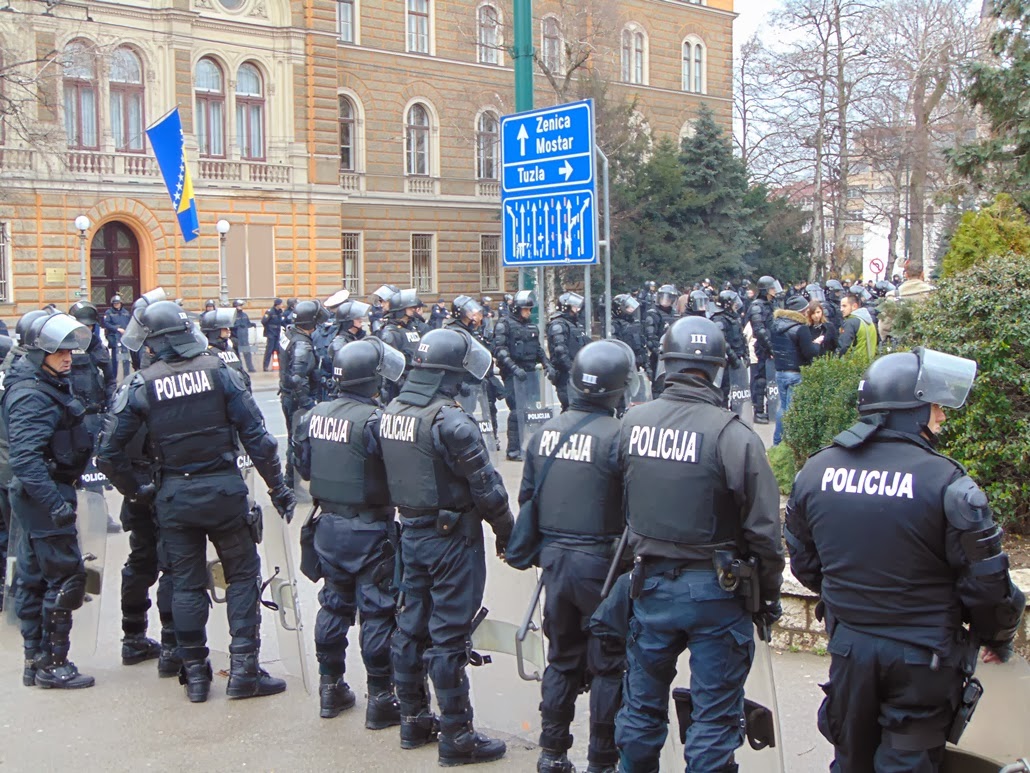
The protests continue in Sarajevo and elsewhere, but a visit to the city centre yesterday painted a different picture, one of mass policing and micro protest. Yesterday, with a heavy police presence (including special public order units with full protective gear, helmets etc.), a small group of protesters was restricted to the pavement and an area in Mali Park (see pictures). Again today, traffic was running normally as the protesters were limited to the park area, albeit behind a far lighter cordon of police in their normal, civilian uniforms.

Throughout the protests, which have lasted for more than a month, demonstrators have been blocking one of the city centre's main cross roads. A few days back, after police decided to let traffic through before the end of the protest, a car injured two protesters. In the following days, taxi drivers joined the protests, using their vehicles to block traffic and thus making an important contribution to the safety of the demonstrators. Meanwhile, in Mostar, the last couple of days have seen new police restrictions on protesters.

All in all, it points towards a more 'robust' response from police to what have been, since Saturday 8 February, peaceful, if disruptive protests. Another Sarajevo Plenum will be held on Wednesday. The Plenum has already voiced its objection to the policing of the protests, including the arrest of three protesters (in German here). We can expect to hear more on this.

In the meantime, regarding the violence of 8 February, police are dealing with this using legislation on terrorism and attacks on the constitutional order. On Friday, two were detained under the relevant provisions of state criminal law.

Police in riot gear

Looking past two riot police to a small number of protesters

Police and protesters, Sarajevo, 7 March


Monday, 3 March 2014

Reading the (Bosnian) Riots

Last summer, William Hunt, Ferida Duraković and Zvonimir Radeljković wrote in Dissent about the possibility that a younger generation of Bosnians might turn to protest. Less than a year on, this has come to pass, but it is not just the younger generation, rather people of all ages. 

My first few days in the country have given me a chance to talk to people about the protests in a number of cities here, and about the violence that took place in early February in Tuzla, Bihać, Mostar, Sarajevo and Zenica, the five largest cities in the Federation of Bosnia and Herzegovina. 

The move from relatively peaceful protests to a swift escalation and spread brought to mind the UK’s own riots in 2011, when what started as a peaceful protest outside a police station in Tottenham became violent, and then spread first to other areas of London and then to other major urban centres in England. 

The most obvious difference between those riots, and the riots here in Bosnia, is the targeted nature of violence. Here, the targets were overwhelmingly government buildings, including cantonal government offices, state institutions, and in Mostar, political party offices. This is in stark contrast to the UK, where a joint Guardian/LSE report, Reading the Riots, paints a picture of a combination of battles with police and the widespread targeting of commercial premises. 

The sources of dissatisfaction bear some similarity, albeit defined by different contexts. The Guardian/LSE study sample of rioters most commonly cited poverty, policing, government policy, unemployment and the shooting of Mark Duggan as important causes of the riots. 

Before the widespread riots of 7 February, protests in Tuzla had centred on the collapse of the canton’s industries, particularly after a series of privatisations. Workers who saw their industries, their jobs and their livelihoods disappear, sought some form of compensation. Alongside this is a strong sense that the politicians here are doing very well in a country suffering widespread poverty and mass unemployment. A common chant heard during protests is lopovi (thieves). Again and again, injustice comes up. But the background of dissatisfaction with the police and policing has not been a factor I have seen here yet. 

In another way, policing may be important. When I was last in Sarajevo in 2005 various international agencies, including the EU and the Office of the High Representative, were focusing on the problem of police coordination in a country with 10 cantonal forces, two entity forces, a special district force, a state force, and a border force. A television campaign featured a police officer pursuing gangsters, only to be stopped by an invisible barrier. While maintaining day to day order is a responsibility of Cantonal police, the security of Federal and State buildings is down to those particular levels of government. So in Sarajevo, when there is a mass protest, which involves attacks on Federal and State buildings, three forces are involved, and it has been suggested that failures in coordination limited the police ability to contain the violence. 

A number of stories are doing the rounds regarding the violence, the extent to which it was orchestrated and if police ineffectiveness might have been part of a political strategy. It’s interesting that these stories have currency, but on the question of the police response, it is also worth remembering how many days passed in the UK before the riots of 2011 were contained. 

As it happened, the violence was more or less limited to two days in Tuzla and one in other cities. Like in London and other UK cities, it was followed by citizen-led clean-up actions. It has also been followed by a more peaceful form of direct democracy, as plenums meet in various locations and pass requests to governments. Already, the Tuzla plenum has claimed a victory in the scrapping of the bijeli hljeb (white bread) payments that representatives receive at the end of their mandate. 

Monday, 24 February 2014

Getting back to Bosnia

It’s nearly 10 years since I left Sarajevo, and I think I’ve got a lot of catching up to do. 
Last month, I spent an evening with a group of UK Army officers discussing my research on international intervention and assistance in Bosnia and Herzegovina. Much of this focused on the respective roles of international police missions (my area) and military missions (theirs) in stabilisation and democratisation. 
Beyond that, and with an eye to possible future deployments, the company were interested in possible sources of unrest and disorder in the future. I didn’t see any trouble on the near horizon. 
Less than a month later, there was barely a window left on the front of the Tuzla Canton Government building, and the BHRT Dnevnik, the national broadcaster’s news programme, was showing images of similar destruction in other cities including Mostar, Sarajevo and Zenica. Like I say, I’ve got a lot of catching up to do. 
My catching up starts properly in a few days, when I begin a six month stay in Sarajevo, working on research, and supported through an association with the Faculty of Criminology, Criminalistics and Security Studies at the University of Sarajevo. 
So, when asked about sources of disorder, why didn’t I see what was just round the corner? 
Perhaps because it was something absolutely new. Watching the news the day after, and talking to a colleague in Sarajevo, there seemed to be a genuine sense of shock at the violence of the protests on Friday 7 February. 
Moreover, while the dissatisfaction underlying the protests may be enduring, the violence itself was fleeting. And watching developments subsequently, there has been a fairly swift move to establish Plenums, forums of citizens gathering, formulating and peacefully articulating their requests to the governing bodies that they feel let down by. 
So maybe I can be forgiven for not seeing what was about to happen. Either way, it’s an exciting and interesting time to be getting back to Bosnia. 
View from Vraca in 2005, Holiday in and state parliament visible

Sarajevo in 2005, the view from Vraca Memorial Park